Rxplanet
Showing posts with label animals. Show all posts

Thursday, January 13, 2011

Why Are Birds Falling From the Sky in Arkansas and elsewhere?


A mysterious rain of thousands of dead birds darkened New Year's Eve in Arkansas, and this week similar reports streamed in from Louisiana, Sweden, and elsewhere. But the in-air bird deaths aren't due to some apocalyptic plague or insidious experiment—they happen all the time, scientists say. The recent buzz, it seems, was mainly hatched by media hype.


At any given time there are "at least ten billion birds in North America ... and there could be as much as 20 billion—and almost half die each year due to natural causes," said ornithologist Greg Butcher, director of bird conservation for the National Audubon Society in Washington, D.C.

But what causes dead birds to fall from the sky en masse? The Arkansas case points to two common culprits: loud noises and crashes.

"Right before they began to fall, it appears that really loud booms from professional-grade fireworks—10 to 12 of them, a few seconds apart—were reported in the general vicinity of a roost of the birds, flushing them out," Rowe said.

"There were other, legal fireworks set off at the same time that might have then forced the birds to fly lower than they normally do, below treetop level, and [these] birds have very poor night vision and do not typically fly at night."

So the firecracker is the murderer of birds???

Wednesday, January 12, 2011

"Vampire Flying Frog" Found; Tadpoles Have Black Fangs

The mountain jungles of Vietnam are home to a new breed of "vampire"—a "flying" tree frog dubbed Rhacophorus vampyrus.

First found in 2008, the 2-inch-long (5-centimeter-long) amphibian is known to live only in southern Vietnamese cloud forests, where it uses webbed fingers and toes to glide from tree to tree. Adults deposit their eggs in water pools in tree trunks, which protects their offspring from predators lurking in rivers and ponds.

"It has absolutely no reason to ever go down on the ground," said study leader Jodi Rowley, an amphibian biologist at the Australian Museum in Sydney.

However, that trick isn't what earned the species its bloodsucking name. Rather, it's the strange curved "fangs" displayed by its tadpoles, which the scientists discovered in 2010.

Frog Fangs Still a Mystery

Tadpoles normally have mouthparts similar to a beak. Instead, vampire tree frog tadpoles have a pair of hard black hooks sticking out from the undersides of their mouths—the first time such fangs have been seen in a frog tadpole. (See more frog pictures.)

The  
Vampire frog tadpoles have small black fangs. Photograph courtesy Jodi Rowley, Australian Museum


The scientists do not yet know what purpose the fangs serve. However, frogs that raise tadpoles in tree-trunk water holes often feed their young by laying unfertilized eggs as meals. The fangs, Rowley speculated, could help in slicing these open.

Friday, December 24, 2010

Megafauna Part II

Continues by Megafauna  Part I.....

6. Sarcosuchus imperator - The Super Croc

Sarcosuchus imperator, or “flesh crocodile emperor,” lived roughly 110 million years ago, when rivers coursed over what is now sub-Saharan Africa. Sarcosuchus prowled the rivers’ banks, crushing fish—and other creatures—in its massive jaws. The giant creature, which lived during the Middle Cretaceous, grew as long as 40 feet (12 meters) and weighed as much as eight metric tons (17,500 pounds). Growth lines were found in cross-sections of the armor plates--one line was laid down each year. A plate from an individual 80% grown had over 40 lines, so we suspect that a fully-grown individual would be at least 50-60 years old - about twice the longevity of living crocs. Its jaws alone were nearly six feet (1.8 meters) long and its more than 100 teeth so powerful that the colossal creature probably consumed small dinosaurs as well as fish, the researchers say.


7. C.Megalodon

Carcharocles megalodon (abbreviated to C.megalodon) was a huge prehistoric shark that lived between 25 and 1.5 million years ago (the Miocene and Pliocene epochs). It is now extinct but no one is sure when C.megalodon died out.
 
Two teeth of great white shark (white) compared to a single tooth of Megalodon (black). A coin 23 mm in width shows the scale.

We will probably never know for sure why Megalodon became extinct. But we can probably be grateful that it did: a 52-foot (16-metre) version of the White Shark with jaws large enough to engulf a rhino would almost certainly make recreational swimming or pleasure boating a LOT less enjoyable.


8. American lion

The American lion, also known as the North American or American cave lion, is an extinct feline known from fossils. It is comparable in size to the Eurasian cave lion, considered to be the second largest species of lion to have ever existed (after the cave lion), and was about 25% larger than the modern African lion.

The American lion averaged 3.5 m (11.5 ft) in length, with a typical male weighing about 235 kg (520 lb), and a typical female weighing about 175 kg (385 lb). It was comparable in size to its close relative the Eurasian cave lion, the modern Amur tiger and the hybrid liger, which is a hybrid that probably never occurs without human interference . They were still smaller than their contemporary, the short-faced bear, which is the largest carnivore of their era.


8. Toxodon
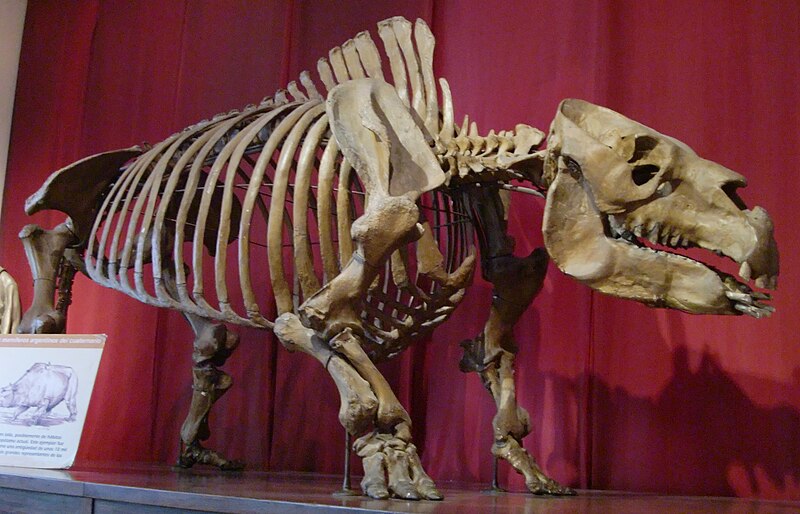
Toxodon was about 2.7 metres (8.9 ft) in body length, and about 1.5 metres (4.9 ft) high at the shoulder and resembled a heavy rhinoceros, with a hippopotamus-like head. Because of the position of its nasal openings, it is believed that Toxodon had a well developed snout. It had a massive skeleton, which suggests that it supported a large muscular body. It had short stout legs with three functional toes, with most of the body weight being borne by the central toe.
The vertebrae were equipped with high apophyses, which most likely supported the massive weight and muscles as well as its powerful head. Toxodon had broad jaws which were filled with bow shaped teeth and incisors. These teeth would have allowed the animal to tear through and bite off the plants and leaves.


9. Andrewsarchus mongoliensis
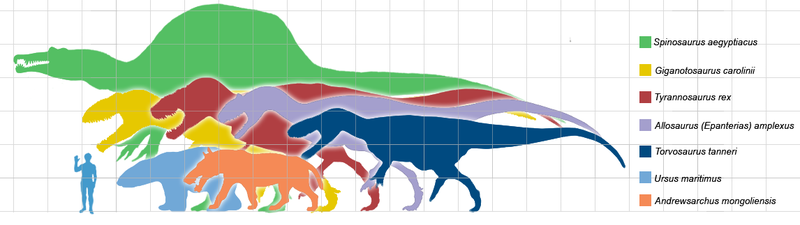
Andrewsarchus was a predatory ungulate (hoofed mammal) that lived during the late Eocene Epoch of the Cenozoic Era. This group constituted the only segment of the ungulates that was carnivorous, and the largest, andrewsarchus mongoliensis was the largest mammalian predator ever to walk on land. Oddly enough, andrewsarchus was most closely related to hippos and pigs rather than to more familiar groups of predators like big cats or dogs. Fossils of this giant have been uncovered in Central Asia, primarily Mongolia.

Extrapolating from the body proportions of similar mesonychids, such as Mesonyx, Andrewsarchus was probably about 4 metres (13 feet) long and may have stood nearly 2 metres (6 feet) at the shoulders. The cranium is about twice the length of an Alaskan brown bear (Ursus arctos middendorffi), but much narrower, and about triple the length of an Rocky Mountain wolf (Canis lupus occidentalis). Since the average brown bear weighs less than 1,000 pounds, and only an extreme specimen of a wolf weighs up to 77 kg (170 lb), we can only suggest, proportionately extrapolating body sizes, that Andrewsarchus probably weighed somewhere between 400 to 1,000 pounds at the most. But since we have only the skull, and no other fossil evidence, this is pure speculation.


10. Smilodon
Smilodon was the largest saber-toothed cat (or saber-toothed tiger). It was a fierce predator about 4-5 feet (1.2-1.5 m) long and 3 feet (0.9 m) tall. It weighed about 440 lbs (200 kg). It was a bit smaller than a modern-day lion (Panthera leo), but much heavier.

It had relatively short legs and a short, bobbed tail. Its front legs were especially powerful. Its body was adapted for springing onto prey, but it was not a very fast runner. Its 12-inch-long (30 cm) skull had 2 huge canine teeth. These saber-like teeth were serrated, oval in cross-section, and up to 7 inches (18 cm) long. Many Smilodon fossils have been found with broken canines; a fossil wolf was found with a Smilodon tooth fragment embedded in its skull. Smilodon had powerful jaws that opened to an angle of about 120°. Today's lions can only open their jaws 65°. Smilodon also had very strong jaw and neck muscles that let it stab prey with its deadly teeth.
Smilodon first appeared about 1.6 million years ago. This ferocious cat went extinct about 11,000 years ago. It lived during the last Ice Age, in which the Earth got much colder than it is now. Ice sheets and glaciers covered much of the land and sea levels fell as sea water froze into polar ice and glaciers. It lived during the Pleistocene Epoch (the early part of the Quaternary Period)

Thursday, December 23, 2010

Megafauna Part I

When we are talking about largest living things ever step foot on Earth, we will think about dinosaurs. This is mostly correct but not totally true. Most of us don't even notice the exist of megafauna, or large animal. These large animals are not dinosaurs.  They are mammals, reptiles and even insects, their sizes can go to amazing big or long. Most of them are already extinct
.
In terrestrial zoology, megafauna (Ancient Greek megas "large" + New Latin fauna "animal") are "giant", "very large" or "large" animals. Their original and most common definition is 100 lb, often rounded in the metric system to 40 or 45 kg.

Here I would like to introduce to you some of mega fauna that already extinct.
1. Jaekelopterus rhenaniae

November 2007, a fearsome fossil claw discovered in Germany belonged to the biggest bug ever known. Jaekelopterus rhenaniae measured some 8.2 feet (2.5 meters) long, scientists estimate, based on the length of its 18-inch (46-centimeter), spiked claw. The newfound fossil creature is estimated to be at least one and a half feet (46 centimeters) longer than any previously known prehistoric sea scorpion, a group called eurypterids. Jaekelopterus lived approximately 390 million years ago. Although called a "sea scorpion", it is speculated to have lived in fresh water rivers and lakes, rather than in saltwater seas.

2. Palorchestes azael


Palorchestes was a ground dwelling marsupial that lived in a woodland habitat. It possessed powerful forelimbs and razor sharp claws, and was capable of ripping through tough vegetation such as bark on tree trunks in order to obtain food. The strong, high-crowned teeth provide further evidence that its diet consisted largely of abrasive vegetation.

3. Rat as big as a Bull

A 4-million-year-old rat skull found at a coastal site in Uruguay set a new world record in the giant rodent category. The 21-inch-long skull is likely to have belonged to a creature as large as a bull and as heavy as a small car, according to researchers’ estimates. The previous record holder was a 1,500-pound, 8-million-year-old guinea pig discovered in Venezuela a few years ago.

4. Indricotherium - largest mammal ever live

Indricotherium is an extinct early relative of modern rhinos that lived during the late Oligocene and early Miocene Epochs of the Cenozoic Era. It was also the largest land mammal ever to live on land, at about 25 feet long, 17 feet tall, and weighing nearly 18 tons. In terms of weight, it was four times larger than a modern day bull elephant and rivaled the size of large sauropod dinosaurs that lived during the Mesozoic. Fossils of indricotherium have been unearthed in the Baluchistan province of Pakistan.

5. Haast’s Eagle - Man-eating Eagle

In New Zealand, both the fossil record and Maori legend tell us of a giant raptor known as Haast’s Eagle (Harpagomis moorei) that was once the largest predator in New Zealand. The giant Haast’s Eagle, it is believed, attacked and killed the 300-pound moa, a flightless bird reminiscent of an ostrich or emu though much larger, as one of its main food sources. Both the Haast’s eagle and the moa are now extinct. The oral legends of the Maori people, however, recall the Haast’s eagle, called pouakia or kokioi in their language, as a flying beast of fearful hunting prowess, and, if they are to be believed, the giant Haast’s eagle may have been hunting and killing human beings around the same time as Columbus was discovering America.

End of part I, hope you enjoy. Read Part II now....

Tuesday, December 21, 2010

'Left-handed' coiling snails survive more snake attacks

Snails with shells that coil anti-clockwise are less likely to fall prey to snakes than their clockwise-coiling cousins, scientists have discovered.


The arrangement of the snakes' teeth makes it difficult for the reptiles to grasp these "left-handed" snails.


The effect of this advantage on the survival of Satsuma snails is so great, say the researchers, that they could separate into a distinct species. Biologists in Japan report the finding in the journal Nature Communications.

Angle of attack

Satsuma snails come in two forms: those which have shells that coil anti-clockwise, considered sinistral or "left-handed" and those that coil clockwise, considered "right-handed".

Land snails copulate face-to-face, and a snail with a reverse-coiled shell has its whole body reversed - including the position of its genitals. This means that oppositely coiled individuals are anatomically incompatible when it comes to mating, so the scientists were puzzled as to why "reverse-coiled" snails continued to survive and evolve.


See the Snake Attack Video on BBC

To investigate, the team, led by Masaki Hoso from Tohoku University in Sendai, set up "predation experiments". They observed snail-eater snakes' (Pareas iwasaki) as they attempted to eat the snails. To consume the soft-bodied molluscs, the predators had to extract them from their shells.

"When attacking, the snake always tilts the head leftward," Dr Hoso told BBC News. The "right-handedness" of this sequence of movements, Dr Hoso explained, means that the snake "cannot grasp [left-handed] or sinistral snails well". The scientists wrote: "This study illustrates how a single gene for reproductive incompatibility could generate a new species by natural selection."

Related Posts Plugin for WordPress, Blogger...

 
Photography Templates | Slideshow Software